Showing posts with label triggers. Show all posts

Friday, October 9, 2020

Piecing events together (third thought download to my life coach on October 7, 2020)

  • Here is what I'm piecing together as I look back on the past six months (edited for this blog): 
Back toward the beginning of our coaching, I expressed disappointment in my prayers and how I felt like I had to gear up for prayer, like it was an event. I basically stopped praying on my knees in the bathroom before going to bed and just kept praying in my mind. But then my mind started not functioning as well. I was looking more and more to coaching sources for answers because I was trying so hard to make progress with our coaching experience. That meant I spent less time on truth from God's sources—although I think coaching and the gospel can complement each other in a beautiful way. 

During that time, I also felt strongly prompted to start writing my book—and made more progress than I have ever made before. I really do believe that I was receiving magnifying and enabling help from heaven. So I spent a little over two months focusing on that project almost exclusively. I stopped watching the "Don't Miss This" videos, which was how I was studying for Come Follow Me, and didn't spend much time in the scriptures—other than searching them and Ensign articles for verses and quotes that inspired the journey I was writing about in my book. I think that's why I was so confused and eventually defeated when my husband kept telling me I couldn't quote them nearly as much as I was. 

Meanwhile, there were no ongoing temple ordinances or refuge from the storm that I found within the temple walls—which used to occur several times each week. There was no more family history (which was effectively turning my office into a temple), institute classes (twice a week for the previous year), church family, or friends strengthening me (except for a handful of walks with my friends—when it used to be 2-3 times weekly). There was just an occasional walk or talk with my ministering sister (who is on her own confusing journey after two years of crisis and turmoil surrounding a difficult situation.) It was just me in a house full of people who don't believe in ways that are supportive to my faith. No ministering brothers (except for one or two texts), no family members I could trust with my emotional or spiritual health (except for my sister and it's hard to figure out a time to talk on the phone), no priesthood blessings, no outside guidance—other than coaching, coaching podcasts, and Instagram. 

The bishop gave my husband authorization to administer the sacrament to me, but he doesn't believe, so he couldn't ever say anything spiritually uplifting. So my church was just listening to "In Humility, Our Savior" by Hilary Weeks while I got myself and our bedroom ready to be a place of sacramental worship. Sometimes, prior to that, I listened to "Broken" by Kenneth Cope (along with a few other EFY songs) while I was taking a shower before getting ready. Therefore, my last lifelines to spirituality were the music and lyrics of Kenneth Cope and Hilary Weeks—I wasn't listening much to her other music because I needed to focus while writing my book. Then I had that complication with Hilary giving permission to use the lyrics in my book after all. And my communication with Kenneth was also very unsettling, although he tried to be supportive. They don't actually know me in real life, though, so that isn't their fault. I think that communication with them ended up being the last crushing blows to the small shred of spirituality and self-confidence I had left. I used to listen to hymns by Vocal Point in my car, but I have driven my car only a handful of times in the past seven months. 

The overarching theme has been that my husband has felt more stress and pressure than he's experienced in 15 years because of the complications to his two jobs by COVID-19, while also trying to earn his master's degree online. He needed more than I could give in support and he had very little energy to give me much support in my challenges. Meanwhile, therapy and coaching were becoming more and more heavy and draining—and, suddenly, all the self-introspection brought self-hate and self-doubt rushing to the surface. Then I started watching our grandson part-time, which left me sleep deprived and emotionally unstable. 

I read these verses in 3 Nephi 18:18-20 last night and again this morning: "Ye must watch and pray always lest ye enter into temptation; for Satan desireth to have you, that he may sift you as wheat. Therefore, ye must always pray unto the Father in my name; And whatsoever ye shall ask the Father in my name, which is right, believing that ye shall receive, behold it shall be given unto you." 

One of the reasons I have avoided those verses in the past is the one that follows them in verse 21: "Pray in your families unto the Father, always in my name, that your wives and your children may be blessed." There hasn't been family prayer in our home for several years. So, I guess the final verse was causing me to feel doubt about the previous two verses. 

And I'm learning more and more that Satan is mean. He can't cause mental illness, but he will definitely exploit any weak spots a person has. I think I was kind of being "sifted like wheat" in every direction. 

I never sent my coach the first 16 chapters of my book. Those are the ones that discuss the spiritual and emotional side of my journey. I discussed the compensatory blessings I've received, even though my prayers haven't been answered about my family's unbelief in the way I have hoped. But most of those spiritual compensatory blessings gradually disappeared as the pandemic went on and my isolation became more destructive. My coach only read the social side of my journey, which is the section I was editing during the last part of these challenges. That part wasn't giving me the spiritual upliftment I needed along the way, and it also emphasized how those things were no longer a part of my life—which is why I started feeling like a hypocrite. 

That is why I was feeling so parched and empty coming into this General Conference. The first session was all tears. The second session started my recovery. The third session began giving me the answer to switch my focus from coaching sources to gospel sources. The Sunday morning session gave me my definitive answer to shift my focus fully back on Jesus. 

By the time the final session ended, I was drained emotionally because conference weekends are the most difficult weekends of the year at our house. I am in my office with the door closed for ten hours—which pushes everyone's buttons. And, it's "insult to injury" for them that it's ten hours listening to people they don't respect, preaching things they don't believe in (and they feel that preaching drives a wedge between me and them). 

Does it make sense? I take full responsibility for my errors in judgment along the way. But I also feel like my physical/emotional illnesses played a part in that—although I'm trying not to use that as an excuse. And I understand that circumstances are neutral, but I think this particular combination of circumstances was a difficult set for me to manage with the challenges I was dealing with behind the scenes. 

So, that is why I'm confused about the coaching experience at this point—especially since I spent $2K on it over the past six months. I think I was supposed to quit listening to other coaches (since they are just dispensing general coaching), but not quit working with you (since it's more personal). I also think that you're probably the only coach in the world who has the empathy and spiritual strengths that I need to help me recover from this unfortunate situation I've ended up in. I feel like I've made the proper course corrections, but I also feel unsettled about my level of self-confidence as I continue my progress on this correct path. 

I'm also anxious about focusing too much on my thoughts and feelings because it seems like that is part of the reason I gradually ended up in this situation. That is my understanding at this point, but I'm not trying to discharge blame. So I'm hoping that the combination of Jesus, my coach, and me can help me back onto solid, steady ground over the next month. 

Wednesday, July 22, 2020

Chapter 12: Dealing with Disappointment

* I wrote these experiences down without much proof-reading. I will revisit this post tomorrow. (I made a few corrections and added a quote in the middle on July 23, 2020.)

            Most healthy marriages have some good times and some bad times, some happiness and some heartache, some adventure and some disappointment. I will always be grateful to my husband, John, for choosing me to be his wife in the first place and for continuing to see the good in me 25 years later. He has been consistently patient, loving, kind, and empathetic through all my years of struggle with mental illness and other health challenges. I will be forever grateful that I made the decision to marry him also. I have tried to be as patient and loving toward him as he has been with me, but I still have a long way to go and I learn a lot from him as we continue our life together.
            I will briefly share our story again with a few extra details. We met in 1993, while serving as full-time missionaries for The Church of Jesus Christ of Latter-day Saints in the Pennsylvania Philadelphia Mission. We discovered that our parents live about five blocks away from each other in Orem, but we never met each other prior to my first area in the mission field. We served in some of the same areas and knew many of the same missionaries and members, but we never actually served near each other during our missions. He was the assistant to the mission president during the final two months of our mission in 1994 and discreetly arranged to have our seats assigned next to each other on the flight back to Utah, since we went home on the same transfer. We even have pictures where we are hugging our individual families in the background of each other’s pictures at the airport. We started dating soon after returning home and ended up getting married in the Bountiful Utah Temple almost exactly a year later in 1995.
            John was very busy working full-time and attending school full-time at Utah Valley State College for the first three years of our marriage. I stopped working a few months after we were married because I had “all day” sickness during my pregnancy with our daughter. She was born nine months and six days after our wedding in 1996. Our son arrived a little less than three years later in 1999. Those were busy years for us and, occasionally, I noticed that John and I weren’t praying, reading the scriptures, or attending the temple together very often. I rationalized that it was just because he was so busy and I assumed he was praying and studying on his own, just like I had been. However, there were nagging doubts about that through the years that followed. My depression and anxiety became much more serious after our son was born and dealing with those complicated circumstances consumed most of our extra attention during the years between 1999 and 2010. During that time, I retreated to our bedroom much more often and John began to shoulder more of the household responsibilities. He also chose to start another company so that he could work from home and be more involved with raising the children.
            By fall 2010, I had completely withdrawn from life. My social anxiety had become so distressing that I rarely left the house and I didn’t even attend church, although I wished I could. John tried hard to be a loving and understanding father and husband through all of this and always took the children to church because he knew it would ease my feelings of guilt. During 2011 and 2012, we decided to change the type of anti-depressant I was taking one more time and then, later, increased the dosage as well. That change helped me to redevelop the habits of attending church and the temple, reading the scriptures, and contributing more to the care of our home and family.
            Unfortunately, in March 2012, my right hip, leg, and foot became inexplicably numb and tingly, so I had several MRIs and other procedures to figure out what was causing it. In addition, John finally told me in August 2012 that he didn’t believe in God or anything related to Him in our religion. He continued to attend church with the family, but it caused me a great deal of distress. However, I felt like he had been loyal to me during my difficult years of depression, so I was going to stay loyal to him with this new situation in our marriage. In January 2013, I was officially diagnosed with Multiple Sclerosis after it was confirmed with a spinal tap. That was disappointing and unsettling news, but we were grateful to finally know what we were dealing with. John was very supportive and helped me with some of my Copaxone injections at home for the three years following my diagnosis.
            Those two life-changing events could have sent me spiraling back into my deep depression. However, I worked hard to be diligent with walking and continuing the other habits I had practiced in the previous two years. They became my anchor as I slowly grew more devastated about John’s unbelief in everything I held most sacred. Then, in September 2013, I had a strong impression that I needed to know more people in my ward (church congregation) and neighborhood. So I gradually started visiting women close to our home and then, as I gained more confidence, I gradually visited women in other congregations and neighborhoods also. I have now visited approximately 500 women and it has changed my life forever. I visited women on all parts of the faith spectrum, was able to help several other women who were suffering from depression, and developed some very close friendships. Through that process, I was gradually able to stop mourning about John’s change in beliefs and developed even more respect for the good person he still is. 
            Dieter F. Uchtdorf spoke in the April 2015 General Conference and his words resonated with me. “Being grateful in our circumstances is an act of faith in God. It requires that we trust God and hope for things we may not see but which are true…. True gratitude is an expression of hope and testimony. It comes from acknowledging that we do not always understand the trials of life but trusting that one day we will. In any circumstance, our sense of gratitude is nourished by the many and sacred truths we do know: that our Father has given His children the great plan of happiness; that through the Atonement of His Son, Jesus Christ, we can live forever with our loved ones; that in the end, we will have glorious, perfect, and immortal bodies, unburdened by sickness or disability; and that our tears of sadness and loss will be replaced with an abundance of happiness and joy, ‘good measure, pressed down, and shaken together, and running over.’… How blessed we are if we recognize God’s handiwork in the marvelous tapestry of life. Gratitude to our Father in Heaven broadens our perception and clears our vision. It inspires humility and fosters empathy toward our fellowmen and all of God’s creation.” (“Gratitude in Any Circumstances,” Ensign, May 2015).
            In fall 2015, I decided to go back to college when our daughter started attending UVU after her high school graduation. Then, in fall 2016, we decided to build a home with main-level living across town, since my MS symptoms were making it difficult for me to climb the stairs several times each day in our current home, which had a four-level-split floor plan. Making all those construction decisions, combined with the financial stress of having a mortgage again, brought more tension back into our marriage. Things improved once we moved into our new home in March 2017, but we started to grow apart again later that year. My schooling, combined with a few visits I still tried to make each week, kept me a little too busy. John has always been a very hard worker and sometimes his work schedule kept him extremely busy as well. I made the decision to withdraw from school in fall 2017, so that I could try to start writing this book. We also decided that marriage therapy was something we would finally be willing to try, since nothing else seemed to be working. Neither of us wanted to separate, but the silence and distance growing between us often made life feel very lonely for each of us, even though we were both still in the marriage.
            After ten therapy visits, we were feeling much closer. We started walking together while holding hands and occasionally went on other dates as well. Meanwhile, I was working on gathering information for my personal history, since writing this book quickly became a daunting task. That gradually turned into family history, which gradually increased my time in the temple exponentially. I also decided to go back to UVU in summer 2018 to finish my associate degree in behavioral science. In addition, I decided to attend a few classes at the UVU institute of religion to earn my diploma for that as well. The combination of all those activities gradually caused distance to creep in again. This time, there were more conflicted feelings surfacing within me because I was more invested in religious learning and worship than I had ever been before.
            Both of our adult children stopped believing in a similar way as their dad and that had been particularly difficult for me through the previous five years. Around the same time in 2018, our daughter started dating someone more seriously. Her dad allowed them to sleep together in her bedroom, but that was extremely difficult for me. I felt that he hadn’t given me a choice when he stopped believing, since he had already decided by the time he told me. I also didn’t feel like I was given a say in the matter with our daughter and her boyfriend. I understood that he was trying to do what was best for everyone involved, but it just triggered a lot of my previous conflicted feelings. That was a very low point in our marriage.
            In 2019, our daughter and her boyfriend told us on mother’s day that she was pregnant. I tried to be supportive, but knew we needed some more marriage therapy. This time, I asked John to choose the therapist and he decided on one who specialized in betrayal trauma. He hadn’t purposely betrayed me and I knew that, but on some level it still felt like a betrayal. Our daughter’s pregnancy added an additional dimension to that complicated swirl of emotion.
            I graduated with an associate degree in November 2019 and continued to immerse myself in family history and temple work. I felt a lot of peace when I was in the temple and I needed that with everything that was happening with our daughter. We continued marriage therapy and our daughter gave birth to a healthy baby boy in January 2020. She had an unforeseen c-section, which caused her to not be able to return immediately to college like she had planned. So we have spent the past seven months together with her sweet baby and it has been such a healing time. The pandemic ended up closing the temples and churches, which brought my full focus back home. Our marriage gradually began to heal again.  
            As I look back, our patterns have been very cyclical and I shoulder my share of the blame. I’m grateful that I have gradually become less rigid in general and have finally realized that I can’t micro-manage or manipulate John with my faith (even though that wasn’t my conscious intention). I’ve learned that we are each only in charge of ourselves and we can only improve or change in the ways that we are currently able to. We also share a great desire to make a positive difference in the lives of people around us and that is very fulfilling. So I now focus on that, instead of our differences in religious belief.  Life will always still be a mix of happiness and disappointment, but we have made it 25 years and that is a huge accomplishment. I’m planning for at least 25 more. 

Thursday, July 9, 2020

Anchored

Here are a couple more insights I've learned recently about thoughts and feelings.

  • There are four parts to every conversation:
1. What we say or what they say. (circumstance or fact)
2. What we mean or what they mean.
3. What they hear or what we hear.
4. What they make it mean or what we make it mean.

What we make a circumstance mean is the story we tell ourselves. We can unravel that story by asking ourselves why we think that and if it is serving us.

If the thought isn't serving us and helping us show up as the person we want to be, then we can choose what to think instead and learn to change that thought.

This is easier said, than done. However, it is entirely possible with more awareness and lots of practice.


  • Remember, the "self-coaching model" is: circumstances trigger our thoughts -> thoughts create our feelings -> feelings drive our actions -> and our actions cause the results in our life.


We may sometimes feel that an unsettling event has "triggered" us. The truth is that triggers are FEELINGS that come from our thoughts about circumstances (the event). "Triggers" are actually just information that can help us understand our thinking better.

We can learn to feel and release negative emotion as we stay anchored to who we want to be through the help of our Savior.

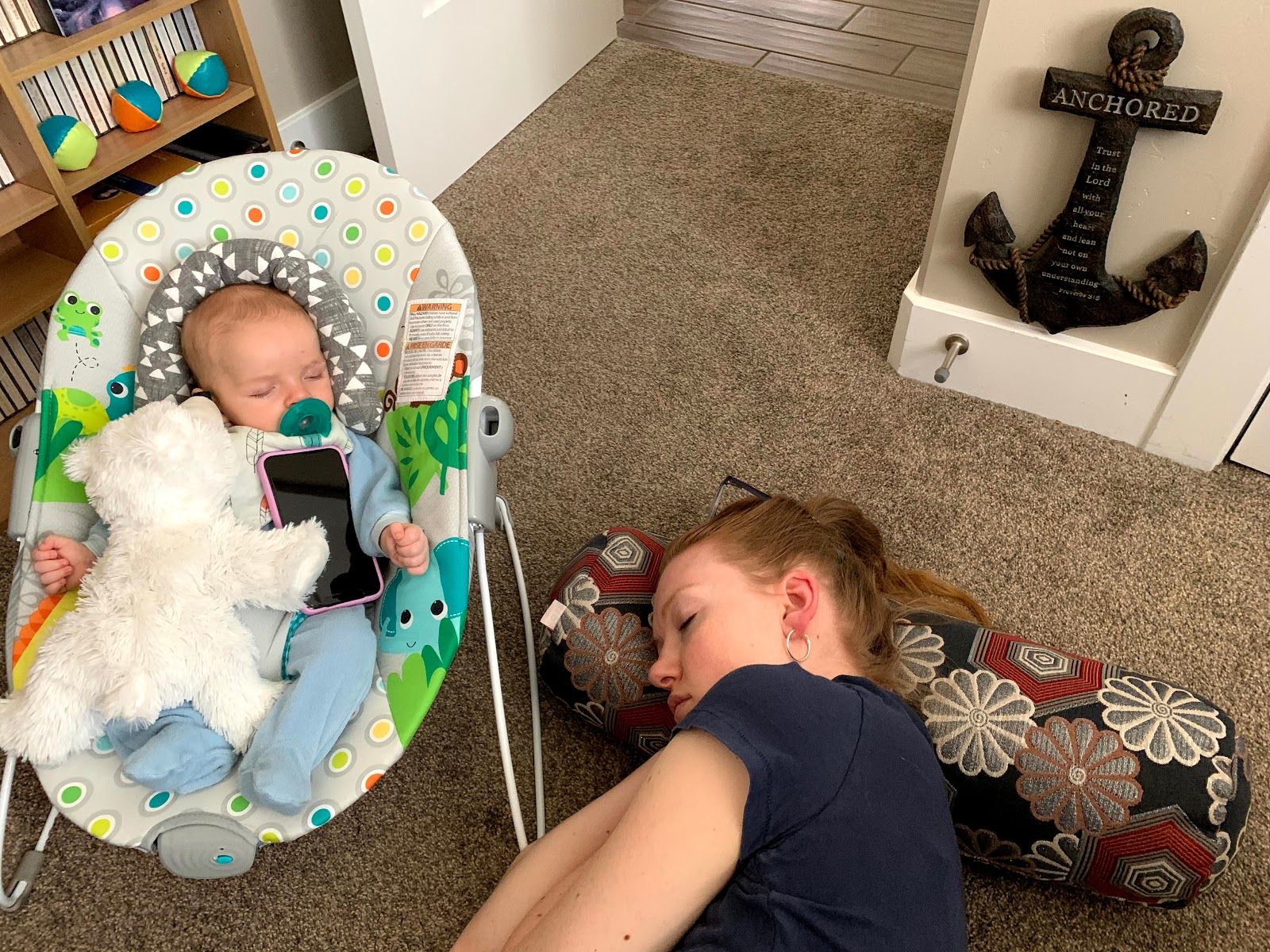
I have an anchor hanging on the wall just above the floor in my office to remind me of the importance of staying anchored in truth. This scripture from the Bible is written on it: "Trust in the Lord with all your heart and lean not on your own understanding" (Proverbs 3:5).

Here are a few pictures of that anchor, along with some of our family:

Our daughter and grandson

Grandpa time

Playing in my office

Me with our grandson on a Sunday afternoon

An example of how this works is the situation with our grandson. Our unmarried daughter told me she was pregnant last year on mother's day. (That is the circumstance, which is neutral.) 

I spent a lot of time worrying about what that would mean for her/our future (thoughts) and struggling with how I felt about her situation as an unmarried mother (feelings). I finally decided that I would just continue to honor her agency and support her in any way I could (that was showing up how I wanted to in the situation). 

Our grandson was born six months ago and it has been the most unexpected blessing. I have been able to spend time with him every day during the pandemic, which wouldn't have been possible if they didn't live with us. I'm grateful that I chose to stay anchored in truth

My good friend gave me the saying behind us: "It doesn't matter how slow you go as long as you don't stop." That phrase has served me well during all the changes I've made over the past decade. It will continue to help me as I'm learning to choose my thoughts and feelings more automatically.