Showing posts with label thoughts. Show all posts

Tuesday, August 18, 2020

Still Not Finished?

Chapter 30 is titled "Grace and Gratitude." On Sunday evening, I posted a few quotes about gratitude, along with a long list of what I am grateful for. 

In addition, I added three quotes about repentance being positive, rather than a punishment (which didn't really fit). However, I was too tired to continue trying to figure it out...

I spent most of today writing about grace, but now I'm having a hard time meshing it with what I wrote previously about gratitude. I'm so close to being finished and now I can't figure out how to finish!

I thought about integrating the positive repentance quotes with what I've already written for chapter 3. The title of that chapter is "Gradually Replacing Negative with Positive." However, I don't really want the chapters in the first section to be as long as the ones at the end of the book. I had no idea so many of these chapters would turn out so incredibly long! 

I would love to just not worry about including the repentance quotes, but I have a nagging feeling that they are important. So, I'm considering renaming chapter 30 as "Changing Through Christ's Grace."

I'm also considering adding two other chapters: 

  • "Losing the Guilt" (for the positive repentance quotes)  
  • "Living with Gratitude and Simplicity" (for the long list of what I'm grateful for, along with some thoughts about enjoying life more fully by keeping it simple).  
The other thing that is becoming increasingly difficult is all the changes I'm having to make with the HTML code because of the cutting and pasting I've done with the quotes before I post them. 

So, I think I'm going to stop posting the changes going forward. The entire first draft of the book is now basically posted on this blog. It has served its purpose and has provided daily accountability for me. 

I'm going to leave the chapter 30 post as I have it now, but it probably won't look like that in the book.

I may return to post about topics I'm learning with coaching. Or this may be it for awhile. 

I used to post on many blogs between 2008 and 2013. They were all private, except for my two inspiration blogs. I have listed those two blogs on the sidebar of this one. So I think that's all.

Farewell again, blogland!

Sunday, July 26, 2020

Chapter 23: Daring to Be Vulnerable

* I added some content to the last paragraph on July 28, 2020.

            Pam Hansen is the author of Running with Angels: The Inspiring Journey of a Woman Who Turned Personal Tragedy into Triumph Over Obesity (2005). It took courage and vulnerability to share her story in such an honest and open way. As a result, she has helped and inspired many other people struggling with their own tragedies and weight loss journeys. We used to live in the same neighborhood as Pam’s family and I feel like we have a common thread in our stories. She was very depressed and went out for a walk one day in spring 2001. That one walk turned into many walks. Those walks eventually resulted in her losing 100 pounds in one year, completing three marathons, and founding the annual Running with Angels 5K run/walk in 2005. In a similar way, I was also very depressed with a different set of struggles and went out for a walk one day in 2011. That one walk turned into many walks. Those walks eventually resulted in me losing 46 pounds in 15 months, learning to deal with mental and physical challenges in a healthier way, and visiting approximately 500 women beginning in fall 2013.
            Pam also wrote Finding the Angel Within: Spirituality,Body Image, and Self-Worth (2008). When I visited her in 2014, she gave me an autographed copy as a gift. I appreciated her thoughtfulness during that visit. I have also been grateful for the kindness and love she has continued to show me. We went out for a healthy treat so we could visit one other time. During that visit, she gave me the gift of Liquid Sunshine in a pump soap from Bath and Body Works. That was the perfect gift, since her cheerful smile and sincere hugs have brightened several of my days during the time I’ve known her.
            In 2015, I walked in the Running with Angels 5K at Thanksgiving Point Gardens with a friend who was also trying to overcome her own challenges with mental illness and obesity. On page 57 of her first book, Pam wrote, “Change takes place one step at a time.” That is a main theme in my book as well. Writing is very difficult for me and I admire her ability to write two inspirational books in such a skillful and uplifting way. Her willingness to be vulnerable has blessed my life and I want to continue trying to follow her good example.
            I am grateful for the research and writing of Dr. BrenĂ© Brown. She is a famous researcher, author, and speaker who focuses much of her work on understanding the interplay between vulnerability, shame, and perfectionism. I will briefly summarize what I’ve learned from her about vulnerability and connection. In order for connection to happen, we have to allow ourselves to really be seen. We need to be willing to let go of what we think we should be in order to be who we really are. We need to learn to embrace vulnerability and understand that vulnerability is not weakness. In the introduction of her book, The Gifts of Imperfection, BrenĂ© Brown encouraged women to “wake up in the morning and think, No matter what gets done and how much is left undone, I am enough” (1). Also, while “going to bed at night thinking, Yes, I am imperfect and vulnerable and sometimes afraid, but that doesn’t change the truth that I am also brave and worthy of love and belonging’” (1).
            A good friend recently reminded me about this talk by Joy D. Jones. “Let me point out the need to differentiate between two critical words: worth and worthiness. They are not the same. Spiritual worth means to value ourselves the way Heavenly Father values us, not as the world values us. Our worth was determined before we ever came to this earth…. On the other hand, worthiness is achieved through obedience. If we sin, we are less worthy, but we are never worth less! We continue to … strive to be like Jesus with our worth intact.”
            She continued, “Despite this marvelous truth, how many of us struggle, from time to time, with negative thoughts or feelings about ourselves? I do. It’s an easy trap. … Thinking small about ourselves does not serve us well. Instead it holds us back. As we’ve often been taught, ‘No one can make you feel inferior without your consent.’ We can stop comparing our worst to someone else’s best. ‘Comparison is the thief of joy.’ In contrast, the Lord assures us that when we have virtuous thoughts, He will bless us with confidence, even the confidence to know who we really are. …We may seldom, if ever, receive huge spiritual manifestations in our lives; but we can frequently savor the sweet whisperings of the Holy Ghost verifying the truth of our spiritual worth… If the love we feel for the Savior and what He did for us is greater than the energy we give to weaknesses, self-doubts, or bad habits, then He will help us overcome the things which cause suffering in our lives. He saves us from ourselves…. If we choose to focus on our negative thoughts and doubt our worth instead of clinging to the Savior, it becomes more difficult to feel the impressions of the Holy Ghost…. Let’s not be confused about who we are! While it is often easier to be spiritually passive than it is to put forth the spiritual effort to remember and embrace our divine identity, we cannot afford that indulgence … As the Savior lifts us to higher ground, we can see more clearly not only who we are but also that we are closer to Him than we ever imagined” (“Value Beyond Measure,” Ensign, Nov. 2017).
            I recently listened to a podcast by my friend, who is also a life coach. I was reminded again that it's okay to not know how to do something, to do it wrong, and to make mistakes. Failing is actually the best way to eventually succeed. Learning to own everything about ourselves and being willing to go through life with our flaws and humanity showing is at the core of vulnerability. These important questions were asked: What if our value was untouched by our humanness? What if we seriously believed that? We can be flawed and still be worthy of love and acceptance (Vulnerability, Pivot Parenting, 28 July 2020). I have been taught these concepts my whole life, but the way she phrased those questions was very helpful to me. When we clearly remember who we are, it gives us confidence to be our true selves. When we are willing to connect with others in a real, authentic, and vulnerable way, it allows them to see us. As we dare to be vulnerable and open in this way, it will help others have the courage to do the same. That is how our hearts can become “knit together in unity and in love one towards another (see Mosiah 18:21). We actually need to know what is in each other’s hearts for that miracle to happen.           

Saturday, July 18, 2020

Chapter 10: Developing Coping Skills

I didn't spend time writing like I hoped to today. I chose to organize some online items (pictures, emails, and contacts) instead. I also took an afternoon nap and enjoyed an evening walk with my husband. However, I did post some additional writing from last year. 

I'm trying to practice what I've been writing about: flexibility and balance, rather than harsh self-judgement and perfectionism. I've decided this blog is about my process while writing, rather than content only. I do want to continue my momentum, though. So I'm just posting a list of ideas before I go to sleep. I will add more substantial content in the future.

 * I spent most of the next afternoon (July 19, 2020) piecing together these six paragraphs.


           A well-known definition of insanity is “doing the same thing over and over and expecting different results.” So, it’s important to just do something different. That means “moving your muscles” in some way. Choose to get up and do anything, instead of sitting still and feeling stuck. When in doubt, move your body and spend more time enjoying the beauty of God’s creations in nature. If the future seems overwhelming, remember that it comes one moment at a time. Write down the things you can control and start there. From that list, work on changing one small thing at a time.
            David A. Bednar compared our lives to a truck that is stuck in the snow. It is the heavier load that ultimately helps it get traction and stop spinning its wheels. He explained, “Each of us… carries a load. Our individual load is comprised of demands and opportunities, obligations and privileges, afflictions and blessings, and options and constraints.” He suggested that we ask ourselves this guiding question to “periodically and prayerfully assess our load: ‘Is the load I am carrying producing the spiritual traction that will enable me to press forward with faith in Christ… and avoid getting stuck?... Sometimes we mistakenly may believe that happiness is the absence of a load. But bearing a load is a necessary and essential part of the plan of happiness. Because our individual load needs to generate spiritual traction, we should be careful to not haul around in our lives so many nice but unnecessary things that we are distracted and diverted from the things that truly matter most” (“Bear Up Their Burdens with Ease,” Ensign, May 2014).
            Our lives can change with every step in the right direction. Choose the next right step and then take that step. Give yourself credit for even the smallest accomplishment. Waiting  to celebrate until you accomplish ALL the progress you’re hoping for isn’t a helpful approach. Life can be hard, so celebrate any and every victory. My mantra has become, “practice makes better” or “practice makes progress.” Our goal is progress, not perfection. Another encouraging phrase is, “If at first you don’t succeed…try setting more realistic goals.” Practice showing compassion to yourself. So many of us think harsh and judgemental thoughts about ourselves. Yet, we would never say those things to a friend who is struggling. Byron Katie wisely explained, “I don’t let go of my thoughts. I meet them with understanding. Then they let go of me.” When you have negative thoughts or feel guilty, anxious, or overwhelmed, you can remind yourself that the Savior’s atonement has already covered this. Just as forgiveness is a process, all negative emotions may need to be put on the altar again and again.
            It’s also important to “work with the brain you have.” For example, if your mind races and it helps to do something with your hands, then have a few activities planned that you can start doing when you notice that you’re feeling depressed or anxious. I find that listening to uplifting music, talks, or podcasts is helpful while doing mundane activities like taking a shower or doing daily chores around the house. I've also learned to attach a new habit I want to form to an existing habit. It reminds me to do it, but it helps that I’m already in motion doing the first habit.  
            I find it helpful to surround myself with uplifting reminders. For example, I have several word boards in my office and walk-in closet that say the words: change, progress, hope, worry less, relax, love, forgive, be thankful, and trust in the Lord. One of my friends gave me a small sign that says, “What’s the best that could happen?” (Rather than focusing on the worst thing that could happen.) Another friend gave me a wall hanging that says, “It doesn’t matter how fast you go as long as you don’t stop.” In other words, the only time we fail is if we quit getting up each time we fall. Just like babies fall a lot when they are learning to walk, we continue to fall when we’re trying something new or different. This helps to gradually build resilience.
            David A. Bednar explained that the Savior’s atonement “enables us to do good and become better in ways that stretch far beyond our mortal capacities…. The unique burdens in each of our lives help us to rely upon (His) merits, mercy, and grace…” (see 2 Nephi 2:8). He encourages us to “pray for the strength to learn from, change, or accept our circumstances rather than praying relentlessly for God to change our circumstances according to our will. We will become agents who act rather than objects that are acted upon (see 2 Nephi 2:14). We will be blessed with spiritual traction” (“Bear Up Their Burdens with Ease,” Ensign, May 2014). On a lighter note, remember that “Everything will be okay in the end. If it's not okay, it's not the end!”  

Sunday, July 12, 2020

Chapter 6: Perspective and Peace

Perspective was my word of the year in 2017. One of the definitions for perspective is the capacity to view things in their true relations or relative importance. Cultivating a perspective of hope has been helpful for me. I remind myself that every day is a new beginning and a fresh start. With this perspective, we have unlimited chances to try again. Being present in the moment, or mindfulness, is another perspective I would like to continue practicing. I try to remind myself that only fairy tales end with “happy ever after.” My goal is to be “happily ever present.”
I’ve also learned that perspective and gratitude complement each other. I appreciate the quote, “gratitude is a magnet for miracles.” Another way to phrase that is to “celebrate the everyday miracles surrounding you,” which is one of my favorite lyrics from my favorite inspirational singer, Hilary Weeks. I will discuss more about gratitude in a later chapter.
Peace was my word of the year in 2018. One way to develop more peace is to be content with what you have, while still taking the initiative to make changes and improve your life. In other words, peace occurs more frequently when we are content, but not complacent. It has been said that “comparison is the thief of happiness.” In the same way, comparison destroys peace. Often, we compare our worst qualities or behavior with the best we observe in other people. That is one of the quickest ways to feel the opposite of peace.
At the end of 2017, I was walking and talking with a good friend. A general authority had recently visited her daughter’s mission and had counseled the missionaries to be “100% in.” I instantly realized that he was speaking of loyalty (not 100% perfect or even 100% obedient – like her missionary assumed). As conscientious women, our minds are frequently bombarded with thoughts of worry, guilt, or shame. In order to feel peace, it’s important to redirect our thinking back to truth in our present circumstances. I continued to ponder and was given the inspiration I needed to deal with difficult circumstances in my own life. It suddenly became very clear to me that I needed to pray for 100% peace when I felt conflicted in my circumstances with family members who have different beliefs than I do.
I had prayed almost constantly for peace up until then, but this new personal revelation changed my perspective almost instantly. As I was thinking about the phrase 100% peace, I realized it was similar to: a “perfect brightness of hope” (see 2 Nephi 31:20), a “fulness of joy” (see 3 Nephi 27:31), and the “pure love of Christ” (see Moroni 7:47). These are all verses found in The Book of Mormon: Another Testament of Jesus Christ. In other words, nothing is perfect, purecompletely fullor 100% – except through the atonement and grace of Jesus ChristThose phrases describe a state of mind or heart. Our difficult or conflicting circumstances may never change, but we can receive that compensatory comfort all along the way.
Boyd K. Packer taught, “While we do not fully understand how the Atonement of Christ was made, we can experience 'the peace of Godwhich passeth all understanding' (Philippians 4:7)" (See "The Touch of the Master's Hand," Ensign, April 2001, 22.) This kind of peace doesn’t make sense to the mortal mind and yet I know it occurs. I believe this is one of the ways the Savior succors us and visits us in our afflictions (see Alma 7:12 and Mosiah 24:14 – also powerful verses in The Book of Mormon: Another Testament of Jesus Christ). A New Testament story illustrates this perfectly. Jesus and his disciples were on a boat and the disciples were afraid when a storm suddenly arose. Mark 4:39 reads, “And [Jesus] arose, and rebuked the wind, and said unto the sea, Peace, be still. And the wind ceased, and there was a great calm.” If Jesus is powerful enough to calm the wind and waves in a stormHe is powerful enough to calm our troubled hearts and restore peace.

Thursday, July 9, 2020

Anchored

Here are a couple more insights I've learned recently about thoughts and feelings.

  • There are four parts to every conversation:
1. What we say or what they say. (circumstance or fact)
2. What we mean or what they mean.
3. What they hear or what we hear.
4. What they make it mean or what we make it mean.

What we make a circumstance mean is the story we tell ourselves. We can unravel that story by asking ourselves why we think that and if it is serving us.

If the thought isn't serving us and helping us show up as the person we want to be, then we can choose what to think instead and learn to change that thought.

This is easier said, than done. However, it is entirely possible with more awareness and lots of practice.


  • Remember, the "self-coaching model" is: circumstances trigger our thoughts -> thoughts create our feelings -> feelings drive our actions -> and our actions cause the results in our life.


We may sometimes feel that an unsettling event has "triggered" us. The truth is that triggers are FEELINGS that come from our thoughts about circumstances (the event). "Triggers" are actually just information that can help us understand our thinking better.

We can learn to feel and release negative emotion as we stay anchored to who we want to be through the help of our Savior.

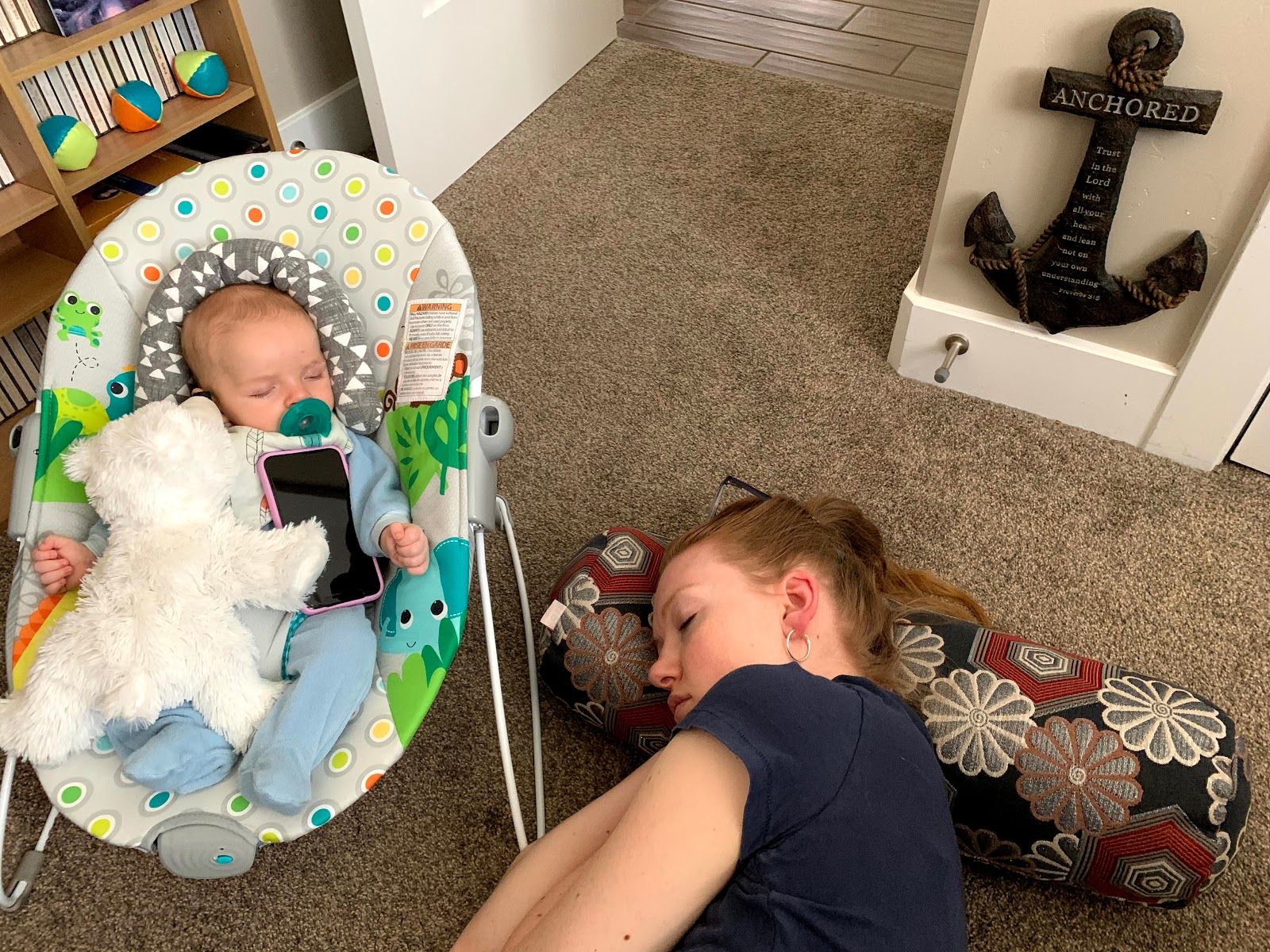
I have an anchor hanging on the wall just above the floor in my office to remind me of the importance of staying anchored in truth. This scripture from the Bible is written on it: "Trust in the Lord with all your heart and lean not on your own understanding" (Proverbs 3:5).

Here are a few pictures of that anchor, along with some of our family:

Our daughter and grandson

Grandpa time

Playing in my office

Me with our grandson on a Sunday afternoon

An example of how this works is the situation with our grandson. Our unmarried daughter told me she was pregnant last year on mother's day. (That is the circumstance, which is neutral.) 

I spent a lot of time worrying about what that would mean for her/our future (thoughts) and struggling with how I felt about her situation as an unmarried mother (feelings). I finally decided that I would just continue to honor her agency and support her in any way I could (that was showing up how I wanted to in the situation). 

Our grandson was born six months ago and it has been the most unexpected blessing. I have been able to spend time with him every day during the pandemic, which wouldn't have been possible if they didn't live with us. I'm grateful that I chose to stay anchored in truth

My good friend gave me the saying behind us: "It doesn't matter how slow you go as long as you don't stop." That phrase has served me well during all the changes I've made over the past decade. It will continue to help me as I'm learning to choose my thoughts and feelings more automatically.

Wednesday, July 8, 2020

Self-coaching reminders about thoughts

I have participated in a Zoom session or phone call with a life coach each week since April 14th. It has been helpful to focus on how to improve my thinking patterns while I've been home during the pandemic. 

I started making some Spark reminders for myself on June 19th to post on Instagram. I thought it might be helpful to post them on here as well. (I found these pictures online, but I don't know who to give the photo credits to.) 

This is Lake Tekapo in New Zealand. 

I've never been there, but it just looked so peaceful to me. Plus, I love purple flowers. 


This is Crested Butte, Colorado. 

The "self coaching model" is: circumstances trigger our thoughts -> thoughts create our feelings -> feelings drive our actions -> and our actions cause the results in our life. 

Therefore, whatever result I'm experiencing in life always references back to the thought. Thoughts are optional because we can learn to choose however we want to think about any circumstance

Actions are either something I am or am NOT doing because of my thoughts and feelings about a circumstance. Therefore, INACTION is still an action. 


Here are two more ways to describe a thought. 


Do you remember this example from psychology class? 

At first, you may only see a young woman or an old woman. But if you focus on seeing something different, eventually the other woman appears. After that, it's not difficult to notice both at the same time. 

I have heard this called a paradigm shift and it's the shift I'm trying to focus on with my thinking. 


This is another perception example from psychology class. 

Because of agency and "opposition in all things" there are always at least two opposing thoughts in each situation that can both seem true. The trick is to choose the one that best serves you in the life you want to have. I'm looking forward to the day when that becomes more automatic for me.


This is the only way to safely bring thoughts into the light for examination. 


This is Banff National Park in Alberta, Canada.  
(I created this from a panoramic photo I found, so it's the left side of the picture. 
The other two parts of the picture are used in the following post about feelings.)

I'm slowly learning to apply these new ways of thinking in my life. It takes a lot of practice